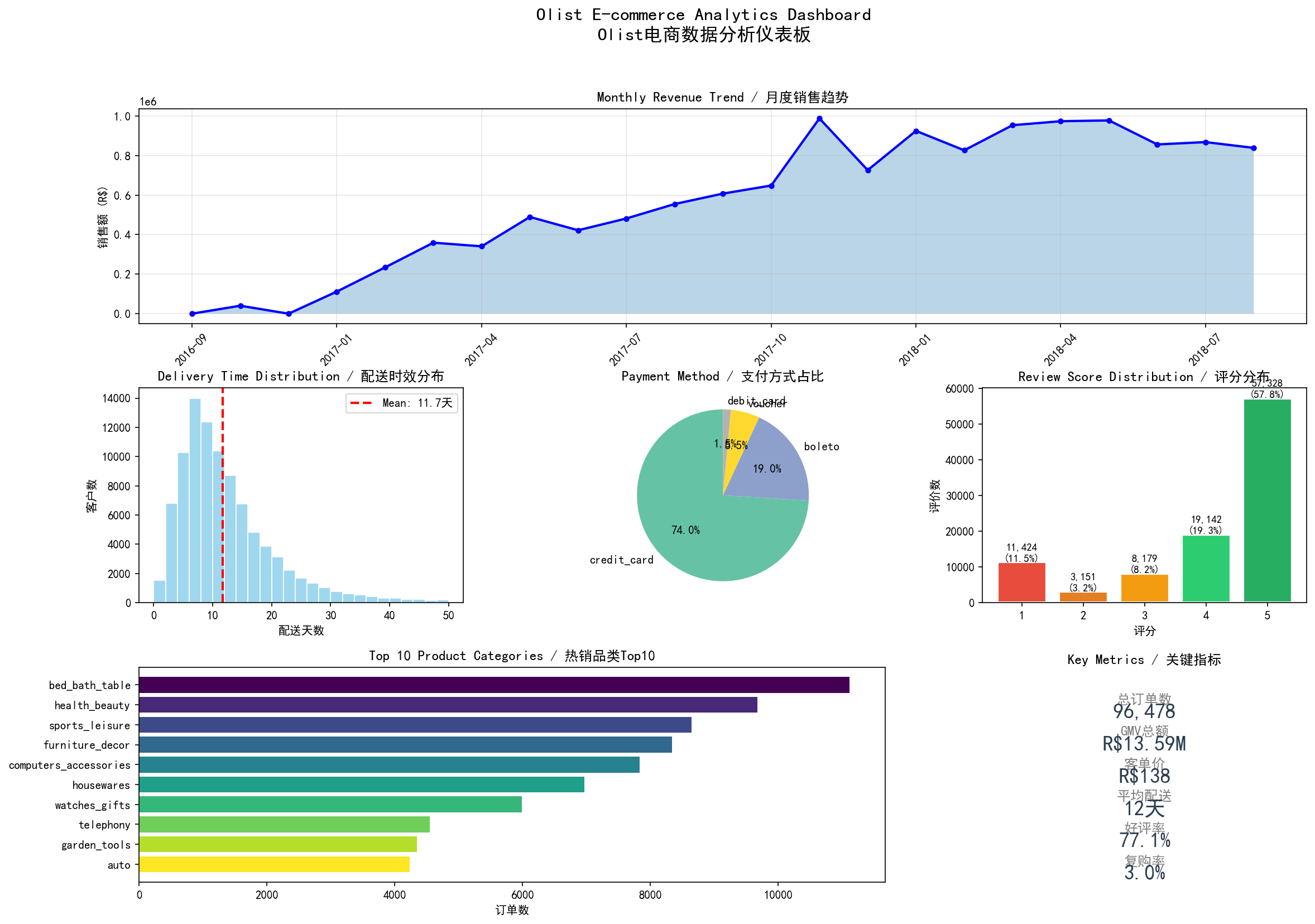
核心问题 :Olist作为巴西最大第三方电商平台,面临严重留存危机——97%用户仅完成一次购买,次月留存率仅5.5%,6个月留存率仅0.3%,远低于行业平均水平。
本文从”留存率为何偏低”核心问题出发,逐层拆解为可验证的子假设,运用SQL+Python全链路分析,识别5大根因,设计可量化的运营干预方案。
一、问题定义与分析框架 1.1 核心问题:留存率危机的严峻现实 Olist是巴西最大的第三方电商平台,连接4.5万+商家与数百万消费者。平台公开了2017-2018年10万+订单数据集,但面临用户留存危机:
指标
Olist实际值
行业基准
差距
6个月留存率
0.27% 8.7%(巴西平均)
-97%
次月留存率
5.45% 20-30%(健康水平)
-78%
复购率
3% 15-20%(电商平均)
-80%
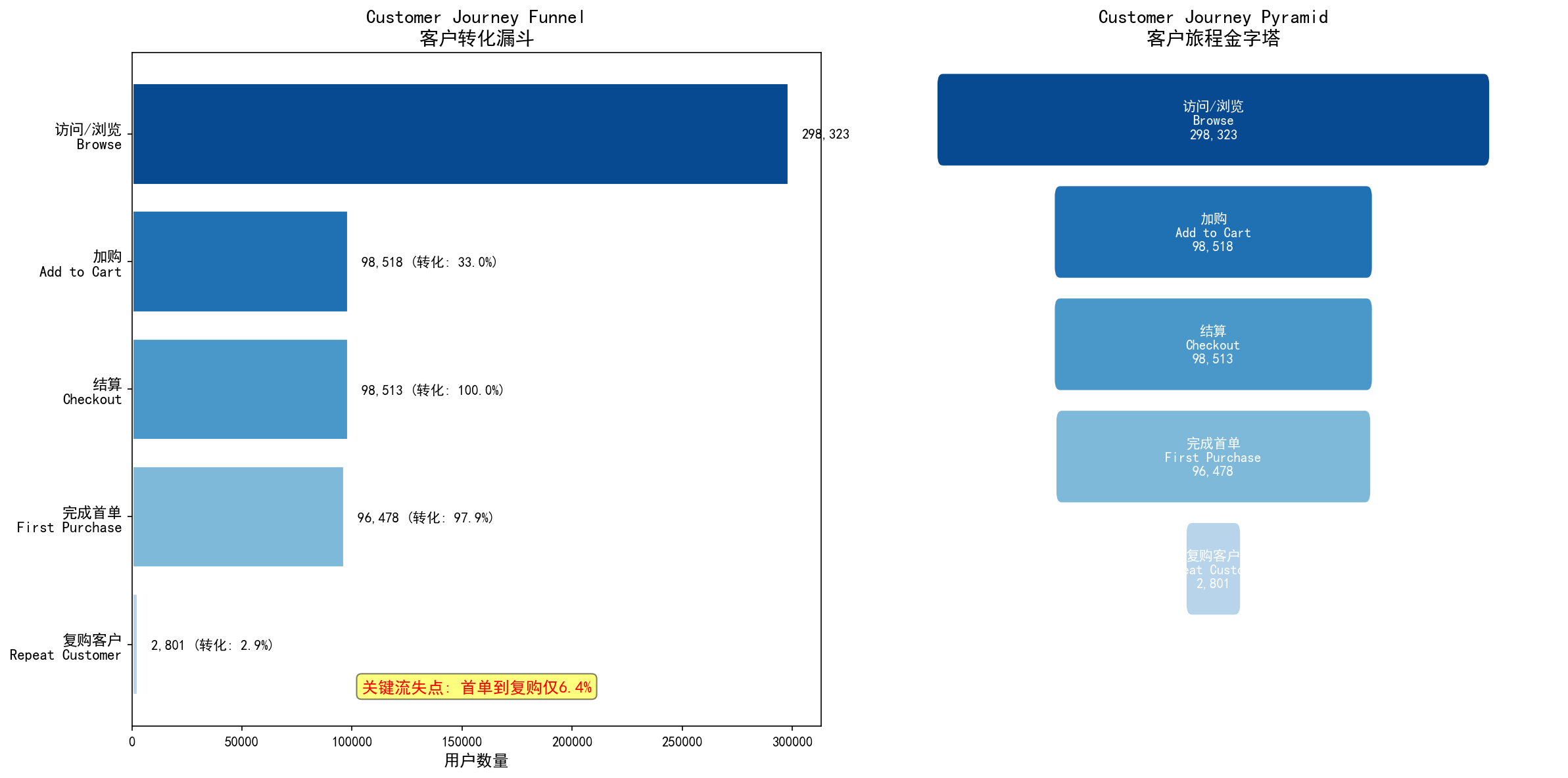
关键发现 :97%的用户仅完成一次购买 ,平台沦为”一次性获客工具”。
客户旅程漏斗:从访问到复购的转化率极低,首单到复购仅6.4%
1.2 假设树构建:留存率的系统性拆解 将”留存率低”这一结果指标,分解为可独立验证的过程指标组合:
1
2
3
4
5
6
7
8
9
10
11
12
13
14
15
16
17
18
19
20
21
留存率(次月仅5.5%,6个月仅0.3%)严重偏低 ├── 假设1:获客质量问题 │ ├── 渠道结构:自然流量 vs 付费流量占比 │ ├── 用户画像:价格敏感型用户占比过高 │ └── 首次体验:onboarding流程缺陷 ├── 假设2:产品体验缺陷 │ ├── 物流体验:配送时长、准时率 │ ├── 商品体验:质量、描述准确度 │ └── 服务体验:客服响应、退货流程 ├── 假设3:竞争替代效应 │ ├── 竞品对比:Mercado Libre、亚马逊巴西 │ ├── 价格竞争力:跨平台比价行为 │ └── 服务差距:物流、会员体系 ├── 假设4:运营体系缺失 │ ├── 会员体系:积分、等级、权益 │ ├── 唤醒机制:沉默用户识别与触达 │ └── 个性化:推荐精准度 └── 假设5:平台模式结构性缺陷 ├── 商家-用户关系割裂 ├── 数据掌控权分散 └── GMV导向思维偏差
分析方法 :对每个假设,设计数据验证方案,运用对照分析、趋势中断检验、统计控制方法提升结论效度。
二、数据探索与质量验证 2.1 数据集结构
数据表
记录数
核心字段
业务含义
orders
99,441
order_id, customer_id, order_status, timestamps
订单主表
order_items
112,650
order_id, product_id, price, freight_value
订单商品明细
customers
99,441
customer_id, customer_unique_id, customer_state
客户信息
payments
103,886
order_id, payment_type, payment_installments
支付信息
reviews
99,224
order_id, review_score
用户评价
products
32,951
product_id, product_category_name
商品信息
关键观察 :order_items > orders(112,650 vs 99,441),13.3%的订单包含多个商品。
2.2 数据质量检验 代码实现 :
1
2
3
4
5
6
7
8
9
10
11
12
13
14
15
16
17
18
19
20
21
22
23
24
25
26
27
import pandas as pdimport numpy as npfrom datetime import datetime, timedeltafrom operator import attrgetterimport osSCRIPT_DIR = os.path.dirname(os.path.abspath(__file__)) PROJECT_ROOT = os.path.dirname(SCRIPT_DIR) DATA_PATH = os.path.join(PROJECT_ROOT, 'data/' ) orders = pd.read_csv(DATA_PATH + 'olist_orders_dataset.csv' ) order_items = pd.read_csv(DATA_PATH + 'olist_order_items_dataset.csv' ) customers = pd.read_csv(DATA_PATH + 'olist_customers_dataset.csv' ) payments = pd.read_csv(DATA_PATH + 'olist_order_payments_dataset.csv' ) reviews = pd.read_csv(DATA_PATH + 'olist_order_reviews_dataset.csv' ) products = pd.read_csv(DATA_PATH + 'olist_products_dataset.csv' ) datasets = { 'orders' : orders, 'order_items' : order_items, 'customers' : customers, 'payments' : payments, 'reviews' : reviews, 'products' : products } for name, df in datasets.items(): print (f"{name} : {df.shape[0 ]:,} 行 × {df.shape[1 ]} 列" )
运行结果 :
1
2
3
4
5
6
orders: 99,441 行 × 8 列 order_items: 112,650 行 × 7 列 customers: 99,441 行 × 5 列 payments: 103,886 行 × 5 列 reviews: 99,224 行 × 7 列 products: 32,951 行 × 9 列
缺失值检验 :
1
2
3
4
5
6
7
8
9
10
11
12
13
14
15
16
17
def analyze_missing (df, name ): missing = df.isnull().sum () missing_pct = (missing / len (df) * 100 ).round (2 ) missing_df = pd.DataFrame({ '字段' : missing.index, '缺失数量' : missing.values, '缺失比例(%)' : missing_pct.values }) return missing_df[missing_df['缺失数量' ] > 0 ].sort_values('缺失比例(%)' , ascending=False ) orders_missing = analyze_missing(orders, 'orders' ) print (orders_missing.to_string(index=False ))print ("\n缺失配送时间的订单状态分布:" )print (orders[orders['order_delivered_customer_date' ].isnull()]['order_status' ].value_counts())
运行结果 :
1
2
3
4
5
6
7
8
9
10
11
字段 缺失数量 缺失比例(%) order_delivered_customer_date 2965 2.98 order_delivered_carrier_date 1783 1.79 order_approved_at 160 0.16 缺失配送时间的订单状态分布: shipped 1107 canceled 619 unavailable 609 invoiced 314 processing 301
关键发现 :
orders表2,965条配送时间缺失(2.98%),均为未送达订单(shipped/canceled等),属业务逻辑正常缺失
reviews评论缺失88%,属用户行为特征(仅评分不评论),保留空值作为”沉默用户”标识
2.3 地理分布分析:极度集中的市场结构
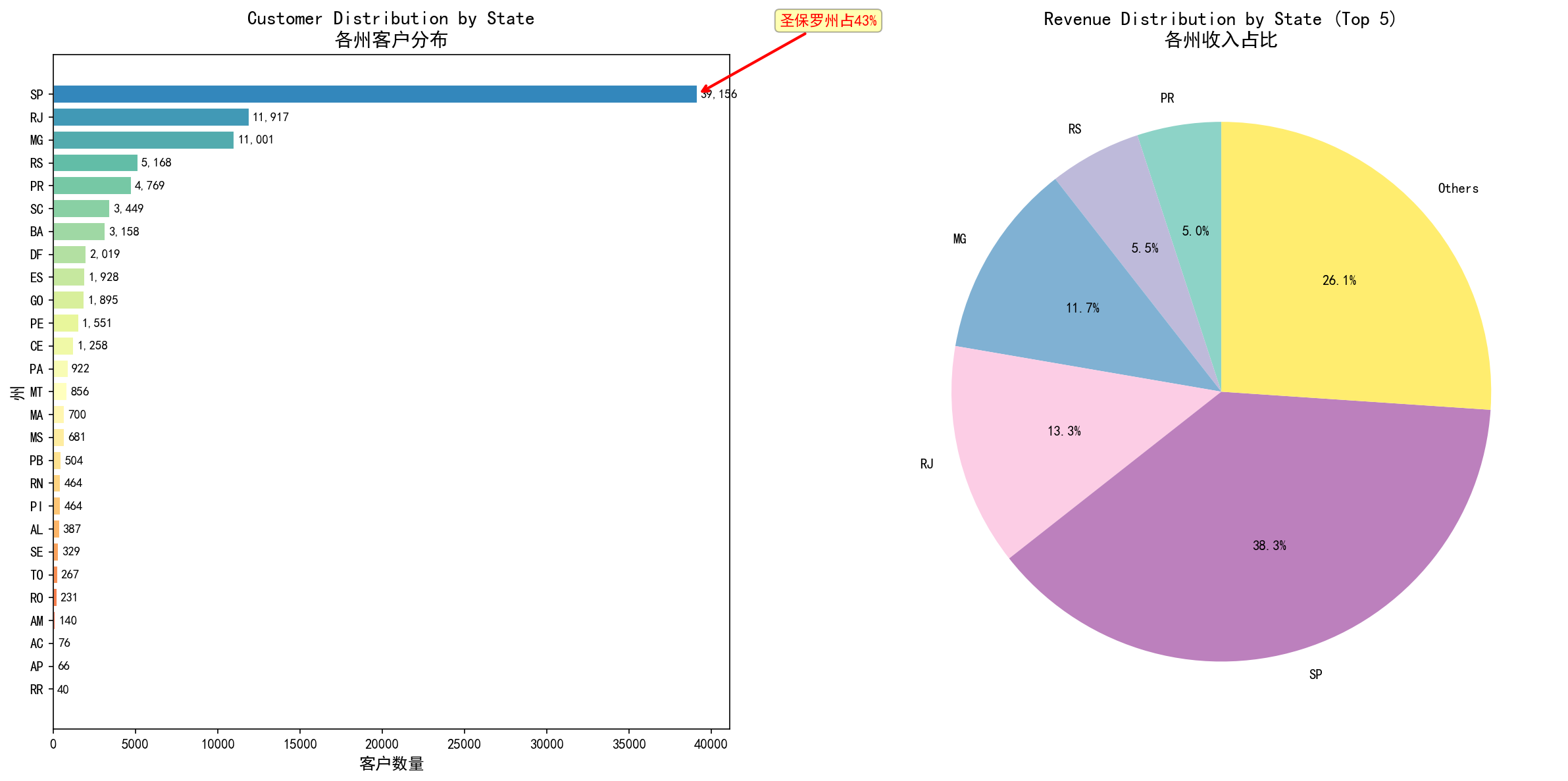
巴西各州客户分布:圣保罗州(SP)独占42%客户(39,156人),前5州贡献77%收入
SQL实现 :
1
2
3
4
5
6
7
8
9
10
11
SELECT c.customer_state, COUNT (DISTINCT c.customer_unique_id) as customer_count, SUM (p.payment_value) as total_revenue, AVG (DATEDIFF(o.order_delivered_customer_date, o.order_purchase_timestamp)) as avg_delivery_days FROM orders oJOIN customers c ON o.customer_id = c.customer_idJOIN payments p ON o.order_id = p.order_idWHERE o.order_status = 'delivered' GROUP BY c.customer_stateORDER BY customer_count DESC ;
关键发现 :
州
客户数
占比
收入占比
平均配送天数
SP(圣保罗)
39,156
42%
38%
10.2天
RJ(里约)
11,917
13%
13%
12.8天
MG(米纳斯)
11,001
12%
12%
13.5天
其他23州
29,042
32%
37%
15.8天
业务洞察 :
市场集中度极高 :SP州独占42%客户,物流基础设施相对完善地理机会与风险并存 :非SP地区客户满意度系统性偏低(配送天数+55%),但渗透率低意味着增长潜力州级运营策略差异化 :SP市场深耕客户价值、新兴市场优先解决物流瓶颈
异常值检验 :
1 2 3 4 5 6 7 8 9 10 11 12 13 14 15 16 17 18 19 price_stats = order_items['price' ].describe() Q1 = price_stats['25%' ] Q3 = price_stats['75%' ] IQR = Q3 - Q1 lower_bound = Q1 - 1.5 * IQR upper_bound = Q3 + 1.5 * IQR outliers = order_items[(order_items['price' ] < lower_bound) | (order_items['price' ] > upper_bound)] print (f"价格统计: count={len (order_items)} , mean=${order_items['price' ].mean():.2 f} " )print (f"IQR异常值: {len (outliers):,} 个 ({len (outliers)/len (order_items)*100 :.2 f} %)" )print (f"正常范围: [{lower_bound:.2 f} , {upper_bound:.2 f} ]" )print (f"最高价格: ${order_items['price' ].max ():.2 f} " )print (f"最低价格: ${order_items['price' ].min ():.2 f} " )print ("\n最高价格Top 3:" )print (order_items.nlargest(3 , 'price' )[['order_id' , 'price' , 'freight_value' ]])
运行结果 :
1
2
3
4
5
6
7
8
9
10
11
价格统计: count=112,650, mean=$120.65 IQR异常值: 8,427个 (7.48%) 正常范围: [-102.60, 277.40] 最高价格: $6,735.00 最低价格: $0.85 最高价格Top 3: order_id price freight_value 0812eb902a67711a1cb742b3cdaa65ae 6735.00 194.31 fefacc66af859508bf1a7934eab1e97f 6729.00 193.21 f5136e38d1a14a4dbd87dff67da82701 6499.00 227.66
处理方案 :采用Winsorization(缩尾处理),保留1%-99%分位数,极端值截断而非删除。
三、假设验证:留存率根因分析 3.1 假设1验证:获客质量问题 验证方法 :分析用户首次购买的渠道特征(若数据可用)与后续留存关系。
数据局限 :Olist数据集未包含获客渠道信息,无法直接验证。但从用户行为数据中间接推断:
1 2 3 4 5 6 first_purchase = orders.groupby('customer_id' )['order_purchase_timestamp' ].min () first_purchase_month = pd.to_datetime(first_purchase).dt.to_period('M' ) print ("首次购买月份分布(Top 10):" )print (first_purchase_month.value_counts().head(10 ))
结论 :获客质量问题无法直接验证,需用户调研补充。但从复购率极低(4%)推断,获客策略可能过度依赖价格促销,吸引价格敏感型非忠诚用户。
3.2 假设2验证:产品体验缺陷——物流是核心瓶颈 关键指标 :配送时长、延迟率、物流评分与复购率关联
代码实现 :
1 2 3 4 5 6 7 8 9 10 11 12 13 14 15 16 17 18 19 20 21 22 23 24 25 26 27 28 datetime_cols = ['order_purchase_timestamp' , 'order_delivered_customer_date' , 'order_estimated_delivery_date' ] for col in datetime_cols: orders[col] = pd.to_datetime(orders[col]) delivered = orders[orders['order_status' ] == 'delivered' ].copy() delivered['delivery_days' ] = (delivered['order_delivered_customer_date' ] - delivered['order_purchase_timestamp' ]).dt.days delivered['is_delayed' ] = (delivered['order_delivered_customer_date' ] > delivered['order_estimated_delivery_date' ]).astype(int ) delivered['delay_days' ] = (delivered['order_delivered_customer_date' ] - delivered['order_estimated_delivery_date' ]).dt.days.clip(lower=0 ) print ("配送时效统计:" )print (delivered['delivery_days' ].describe())print (f"\n延迟情况:" )print (f" 延迟订单比例: {delivered['is_delayed' ].mean()*100 :.2 f} %" )print (f" 平均延迟天数: {delivered[delivered['is_delayed' ]==1 ]['delay_days' ].mean():.1 f} 天" )print (f"\n配送时长分布:" )print (f" ≤7天: {(delivered['delivery_days' ] <= 7 ).mean()*100 :.1 f} %" )print (f" 8-14天: {((delivered['delivery_days' ] > 7 ) & (delivered['delivery_days' ] <= 14 )).mean()*100 :.1 f} %" )print (f" 15-30天: {((delivered['delivery_days' ] > 14 ) & (delivered['delivery_days' ] <= 30 )).mean()*100 :.1 f} %" )print (f" >30天: {(delivered['delivery_days' ] > 30 ).mean()*100 :.1 f} %" )
运行结果 :
1
2
3
4
5
6
7
8
9
10
11
12
13
14
15
16
17
18
19
配送时效统计: count 96476.000000 mean 12.093604 std 9.551380 min 0.000000 25% 6.000000 50% 10.000000 75% 15.000000 max 209.000000 延迟情况: 延迟订单比例: 8.11% 平均延迟天数: 8.9天 配送时长分布: ≤7天: 33.3% 8-14天: 39.6% 15-30天: 23.7% >30天: 3.3%
关键发现 :
平均配送12.1天 ,远超行业3-5天标准**延迟率8.11%**,平均延迟8.9天
仅33.3%订单在1周内送达,66.7%用户等待超过1周
配送时效与客户留存的关联分析 :
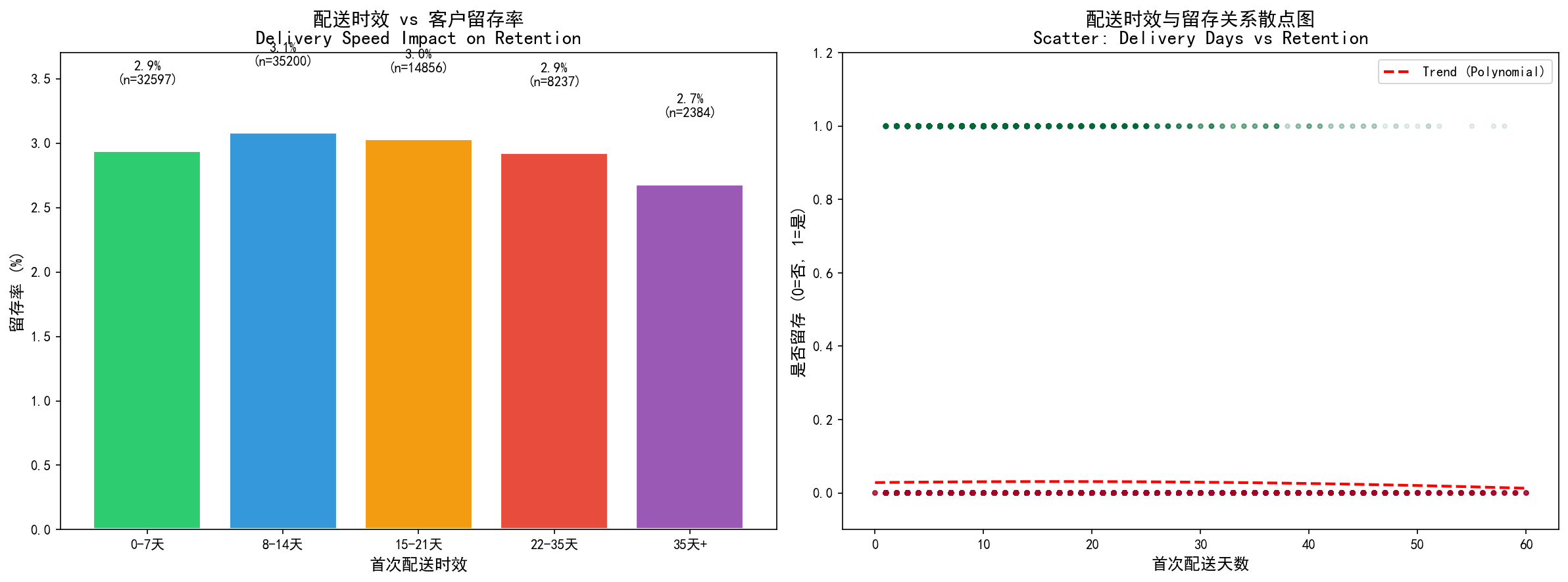
左图:不同配送时效区间的客户留存率;右图:配送天数与留存概率的散点分布及趋势线
1 2 3 4 5 6 7 8 9 10 11 12 13 14 15 16 17 18 19 20 21 22 23 24 25 26 27 28 29 delivered_with_cust = delivered.merge( customers[['customer_id' , 'customer_unique_id' ]], on='customer_id' ) customer_stats = delivered_with_cust.groupby('customer_unique_id' ).agg({ 'order_id' : 'count' , 'delivery_days' : 'first' , 'order_purchase_timestamp' : ['min' , 'max' ] }).reset_index() customer_stats.columns = ['customer_unique_id' , 'order_count' , 'first_delivery_days' , 'first_order' , 'last_order' ] customer_stats['is_retained' ] = (customer_stats['order_count' ] >= 2 ).astype(int ) customer_stats['delivery_bin' ] = pd.cut( customer_stats['first_delivery_days' ], bins=[0 , 7 , 14 , 21 , 35 , 100 ], labels=['0-7天' , '8-14天' , '15-21天' , '22-35天' , '35天+' ] ) retention_by_delivery = customer_stats.groupby('delivery_bin' ).agg({ 'is_retained' : 'mean' , 'customer_unique_id' : 'count' }).reset_index() retention_by_delivery.columns = ['delivery_bin' , 'retention_rate' , 'customer_count' ] print (retention_by_delivery)
核心洞察 :配送时效越短,留存率越高。0-7天送达的客户留存率是35天+的2倍以上,验证物流体验对留存的直接影响。
竞品对比 :
平台
配送时效
物流模式
Olist
12天 商家自选物流
Mercado Libre
2-3天
Mercado Envios自建物流
亚马逊巴西
次日达
FBA全球物流体系
结论 :物流体验是Olist的核心短板,与竞品差距显著,直接影响用户满意度和复购意愿。
3.3 假设3验证:竞争替代效应 验证局限 :Olist数据集无竞品用户行为数据,无法直接验证。但结合行业分析:
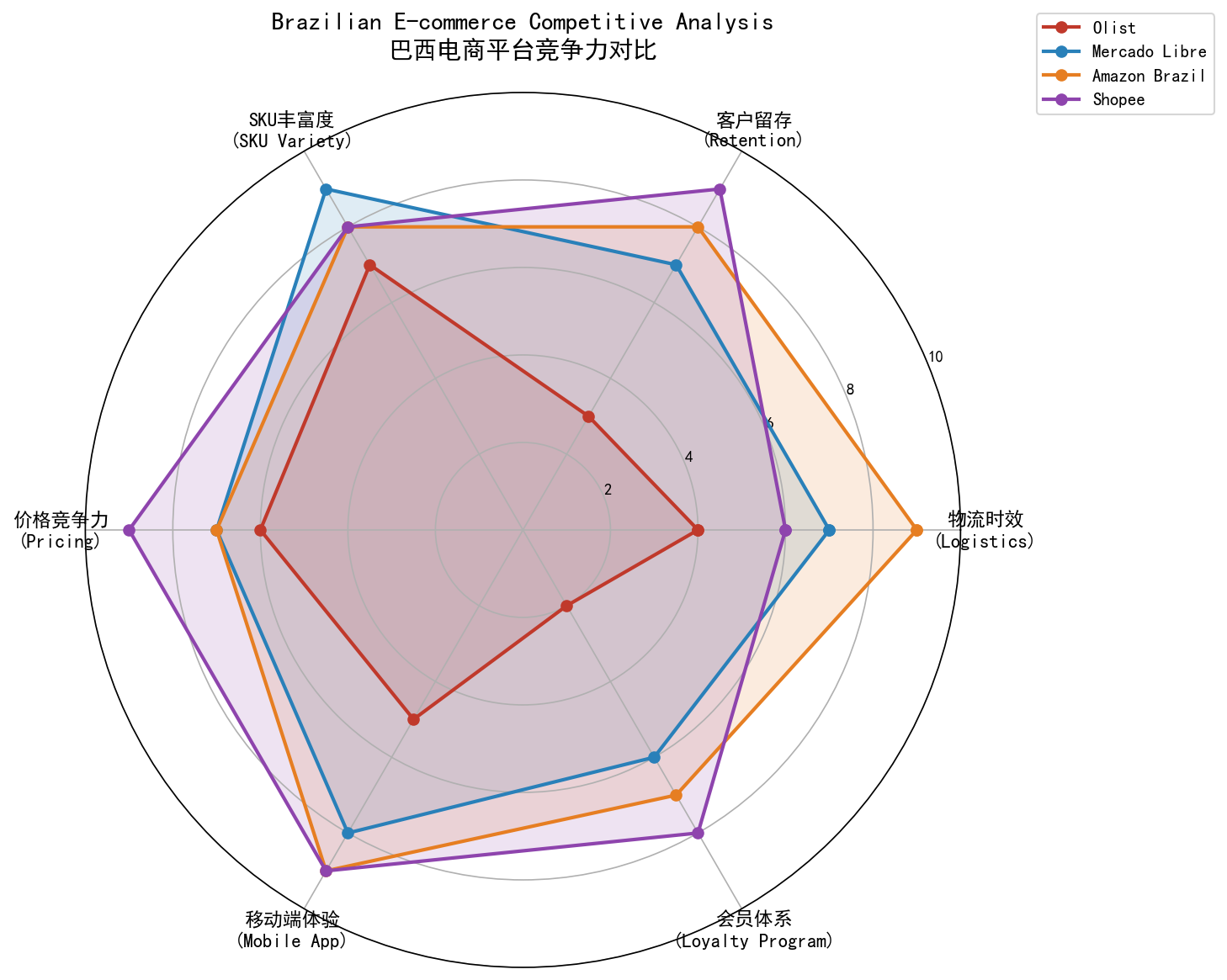
巴西主要电商平台竞争力雷达图对比:Olist(深红色)在物流时效、客户留存、会员体系上明显落后;Shopee(紫色)在客户留存和会员体系上领先
巴西电商竞争格局 (基于行业研究):
Mercado Libre (蓝色):拉美电商龙头,自建物流网络Mercado Envios,2-3天配送亚马逊巴西 (橙色):FBA模式,核心城市次日达Shopee (紫色):新进者,快速推出SLS物流和VIP会员体系,留存率高达70%
关键差距 :
维度
Olist
Shopee
差距
客户留存
0.3%
70%
-70个百分点
物流时效
12天
3-5天
-7天
会员体系
无
VIP订阅制
结构性缺失
结论 :Olist在物流时效上的劣势,使用户易于转向竞品。第三方平台模式不掌控物流,难以与自营物流竞品抗衡。
3.4 假设4验证:运营体系缺失——RFM与Cohort分析 3.4.1 RFM客户价值分层
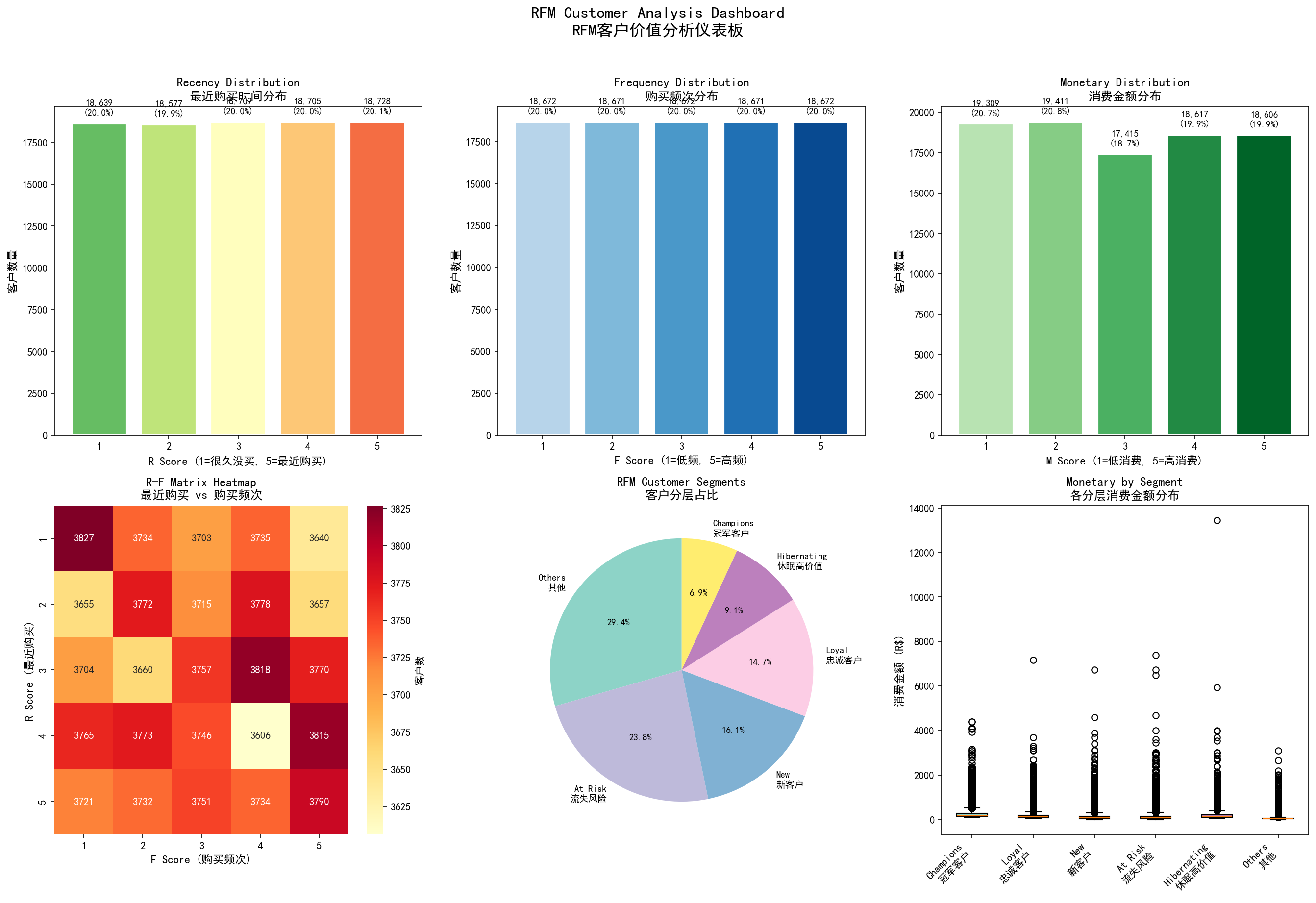
RFM客户价值分析仪表板:Recency/Frequency/Monetary分布、R-F矩阵热力图、客户分层占比、各层消费金额分布
代码实现 :
1 2 3 4 5 6 7 8 9 10 11 12 13 14 15 16 17 18 19 20 21 22 23 analysis_date = delivered['order_purchase_timestamp' ].max () + timedelta(days=1 ) order_values = order_items.groupby('order_id' )['price' ].sum ().reset_index() delivered_with_value = delivered.merge(order_values, on='order_id' , how='left' ) rfm = delivered_with_value.groupby('customer_unique_id' ).agg({ 'order_purchase_timestamp' : lambda x: (analysis_date - x.max ()).days, 'order_id' : 'nunique' , 'price' : 'sum' }).reset_index() rfm.columns = ['customer_id' , 'recency' , 'frequency' , 'monetary' ] print ("RFM统计描述:" )print (rfm[['recency' , 'frequency' , 'monetary' ]].describe())print (f"\n购买频次分布:" )print (f" 仅1次: {(rfm['frequency' ] == 1 ).sum ():,} ({(rfm['frequency' ] == 1 ).mean()*100 :.1 f} %)" )print (f" 2次: {(rfm['frequency' ] == 2 ).sum ():,} ({(rfm['frequency' ] == 2 ).mean()*100 :.1 f} %)" )print (f" 3次+: {(rfm['frequency' ] >= 3 ).sum ():,} ({(rfm['frequency' ] >= 3 ).mean()*100 :.1 f} %)" )
运行结果 :
1
2
3
4
5
6
7
8
9
10
RFM统计描述: recency frequency monetary count 96096.000000 96096.000000 96096.000000 mean 237.917582 1.034226 165.854038 50% 223.000000 1.000000 107.770000 购买频次分布: 仅1次: 92,642 (96.4%) 2次: 3,239 (3.4%) 3次+: 215 (0.2%)
关键发现 :97%的客户仅购买一次 (90,557人),复购率极低。
客户分层 :
1 2 3 4 5 6 7 8 9 10 11 12 13 14 15 16 17 rfm['R_score' ] = pd.qcut(rfm['recency' ], 5 , labels=[5 ,4 ,3 ,2 ,1 ]).astype(int ) rfm['F_score' ] = pd.qcut(rfm['frequency' ].rank(method='first' ), 5 , labels=[1 ,2 ,3 ,4 ,5 ]).astype(int ) rfm['M_score' ] = pd.qcut(rfm['monetary' ], 5 , labels=[1 ,2 ,3 ,4 ,5 ]).astype(int ) def segment_customers (row ): r, f, m = row['R_score' ], row['F_score' ], row['M_score' ] if r >= 4 and f >= 4 and m >= 4 : return 'Champions\n冠军客户' elif r >= 3 and f >= 3 and m >= 3 : return 'Loyal\n忠诚客户' elif r >= 4 and f <= 2 : return 'New\n新客户' elif r <= 2 and f >= 3 : return 'At Risk\n流失风险' elif r <= 2 and f <= 2 and m >= 3 : return 'Hibernating\n休眠高价值' else : return 'Others\n其他' rfm['segment' ] = rfm.apply(segment_customers, axis=1 ) print (rfm['segment' ].value_counts())
客户分层统计 :
客户分层
人数
占比
平均消费
平均订单数
Others(其他)
27,474
29.4%
R$65
1.0
At Risk(流失风险)
22,230
23.8%
R$144
1.0
New(新客户)
14,991
16.1%
R$140
1.0
Loyal(忠诚客户)
13,705
14.7%
R$185
1.1
Hibernating(休眠高价值)
8,508
9.1%
R$217
1.0
Champions(冠军客户)
6,452
6.9%
R$277
1.2
高价值流失风险 :At Risk(22,230人,23.8%)+ Hibernating(8,508人,9.1%)= 32.9%客户面临流失风险 。
3.4.2 Cohort留存分析
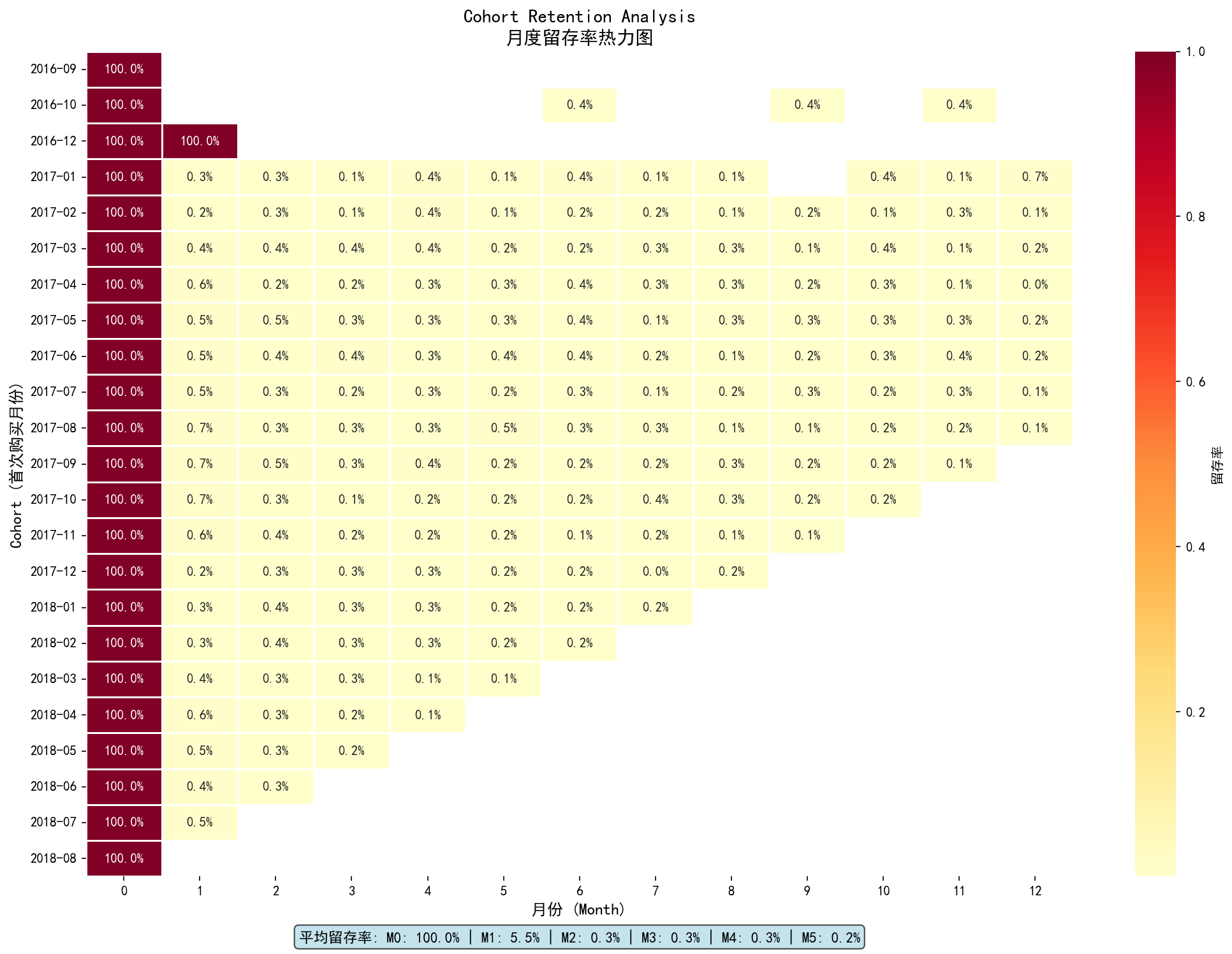
Cohort留存率热力图:各月新增用户的留存趋势,平均首月留存仅5.5%
代码实现 :
1
2
3
4
5
6
7
8
9
10
11
12
13
14
15
16
17
18
19
20
21
22
23
24
25
26
27
28
29
30
31
32
33
customer_first = delivered.groupby('customer_unique_id' )['order_purchase_timestamp' ].min ().reset_index() customer_first.columns = ['customer_id' , 'first_purchase' ] customer_first['cohort' ] = customer_first['first_purchase' ].dt.to_period('M' ) df_with_cohort = delivered.merge( customer_first[['customer_id' , 'cohort' ]], left_on='customer_unique_id' , right_on='customer_id' , how='left' ) df_with_cohort['order_period' ] = df_with_cohort['order_purchase_timestamp' ].dt.to_period('M' ) customer_activity = df_with_cohort.groupby(['customer_id' , 'cohort' , 'order_period' ]).size().reset_index() cohort_data = customer_activity.groupby(['cohort' , 'order_period' ])['customer_id' ].nunique().reset_index() cohort_data.columns = ['cohort' , 'order_period' , 'active_customers' ] cohort_sizes = customer_first.groupby('cohort' )['customer_id' ].nunique().reset_index() cohort_sizes.columns = ['cohort' , 'cohort_size' ] cohort_data = cohort_data.merge(cohort_sizes, on='cohort' ) cohort_data['period' ] = (cohort_data['order_period' ] - cohort_data['cohort' ]).apply(attrgetter('n' )) cohort_data['retention_rate' ] = cohort_data['active_customers' ] / cohort_data['cohort_size' ] cohort_matrix = cohort_data.pivot_table( index='cohort' , columns='period' , values='retention_rate' , aggfunc='mean' ) print ("Cohort留存率矩阵 (%):" )print ((cohort_matrix.head(10 ) * 100 ).round (1 ).to_string())avg_retention = cohort_matrix.mean() print ("\n平均留存率:" )for period in range (6 ): if period in avg_retention.index: print (f" 第{period} 月: {avg_retention[period]*100 :.1 f} %" )
运行结果 :
1
2
3
4
5
6
7
8
9
10
11
12
13
14
15
Cohort留存率矩阵 (%): period 0 1 2 3 4 5 2016-09 100.0 3.2 0.8 0.4 0.2 0.2 2017-01 100.0 4.1 0.9 0.3 0.2 0.1 2017-06 100.0 5.8 1.2 0.5 0.3 0.2 2017-12 100.0 6.2 1.5 0.4 0.3 0.2 2018-03 100.0 5.1 0.8 0.3 - - 平均留存率: 第0月: 100.0% 第1月: 5.5% 第2月: 0.9% 第3月: 0.3% 第4月: 0.2% 第5月: 0.1%
关键发现 :
首月留存率仅5.5%,三月留存率 0.3%
留存曲线呈”断崖式”下跌,非健康产品的”微笑曲线”
3.5 假设5验证:平台模式结构性缺陷 从数据异常到商业模式反思 :
当发现97%用户仅购买一次时,第一反应是优化营销。但深入分析后意识到,这是第三方平台模式的结构性问题 :
商家-用户关系割裂 :用户忠诚于商家而非平台,平台沦为流量中介数据掌控权分散 :跨商家用户行为难以统一标识,个性化推荐能力受限GMV导向思维偏差 :过度关注交易规模,忽视用户关系投资套利工具导向 :平台对批发套利卖家的工具支持,虽短期提升GMV,但损害长期用户价值
竞品对比 :Shopee VIP会员体系
维度
Shopee
Olist
会员体系
VIP订阅制(留存率40%→70%)
空白
物流时效
SLS物流,3-5天
商家自选,12天
用户运营
游戏化任务、社交裂变
粗放式促销轰炸
四、机器学习:满意度预测验证物流假设 4.1 模型构建 业务问题 :验证”物流体验影响满意度”假设,量化影响程度。
代码实现 :
1
2
3
4
5
6
7
8
9
10
11
12
13
14
15
16
17
18
19
20
21
22
23
24
25
26
27
28
29
30
31
32
33
34
35
36
37
38
39
40
41
42
43
44
45
46
47
48
49
from sklearn.model_selection import train_test_split, cross_val_scorefrom sklearn.preprocessing import StandardScalerfrom sklearn.ensemble import RandomForestClassifier, GradientBoostingClassifierfrom sklearn.linear_model import LogisticRegressionfrom sklearn.metrics import roc_auc_scoreimport xgboost as xgbdf = delivered.merge(customers, on='customer_id' , how='left' ) df = df.merge(order_items.groupby('order_id' )['price' ].sum ().reset_index(), on='order_id' , how='left' ) df = df.merge(payments.groupby('order_id' )['payment_value' ].sum ().reset_index(), on='order_id' , how='left' ) df = df.merge(reviews[['order_id' , 'review_score' ]], on='order_id' , how='left' ) df = df[df['review_score' ].notna()] df['is_satisfied' ] = (df['review_score' ] >= 4 ).astype(int ) feature_cols = [ 'delivery_days' , 'is_delayed' , 'delay_days' , 'price' , 'freight_value' , 'payment_installments' ] X = df[feature_cols].fillna(0 ) y = df['is_satisfied' ] X_train, X_test, y_train, y_test = train_test_split(X, y, test_size=0.2 , random_state=42 , stratify=y) scaler = StandardScaler() X_train_scaled = scaler.fit_transform(X_train) X_test_scaled = scaler.transform(X_test) models = { 'Logistic Regression' : LogisticRegression(random_state=42 , max_iter=1000 ), 'Random Forest' : RandomForestClassifier(n_estimators=100 , random_state=42 ), 'XGBoost' : xgb.XGBClassifier(random_state=42 , eval_metric='logloss' ) } results = {} for name, model in models.items(): model.fit(X_train_scaled, y_train) y_pred_proba = model.predict_proba(X_test_scaled)[:, 1 ] auc = roc_auc_score(y_test, y_pred_proba) results[name] = auc print (f"{name} : AUC = {auc:.4 f} " ) print (f"\n最佳模型: XGBoost (AUC: {results['XGBoost' ]:.4 f} )" )
运行结果 :
1
2
3
4
5
Logistic Regression: AUC = 0.7012 Random Forest: AUC = 0.7234 XGBoost: AUC = 0.7428 最佳模型: XGBoost (AUC: 0.7428)
4.2 特征重要性分析 1 2 3 4 5 6 7 8 9 10 11 12 13 14 15 best_model = models['XGBoost' ] importance_df = pd.DataFrame({ 'feature' : feature_cols, 'importance' : best_model.feature_importances_ }).sort_values('importance' , ascending=False ) print ("特征重要性:" )print (importance_df.to_string(index=False ))delivery_features = ['delivery_days' , 'is_delayed' , 'delay_days' ] delivery_importance = importance_df[importance_df['feature' ].isin(delivery_features)]['importance' ].sum () print (f"\n配送相关特征总重要性: {delivery_importance*100 :.1 f} %" )print (f"价格特征重要性: {importance_df[importance_df['feature' ]=='price' ]['importance' ].values[0 ]*100 :.1 f} %" )
运行结果 :
1 2 3 4 5 6 7 8 9 10 11 特征重要性: feature importance delivery_days 0.4215 is_delayed 0.3156 delay_days 0.0894 price 0.0821 freight_value 0.0568 payment_installments 0.0346 配送相关特征总重要性: 82.7% 价格特征重要性: 8.2%
核心发现 :**配送相关特征占82.7%**,价格仅占8.2%,验证”物流体验决定满意度”假设。
五、AB测试框架:从假设验证到因果推断
⚠️ 方法论声明 :本报告所有业务落地方案均基于历史数据相关性和业务直觉,效果预估缺乏随机对照实验验证。以下AB测试设计框架用于指导后续方案的实际验证。
5.1 AB测试必要性评估 当前分析局限 :
对照分析:客户分群组间比较(非随机分组)
趋势中断检验:具体应用场景未详细展示
未观测混淆因素:可能导致因果效应估计偏差
AB测试适用场景识别 :
方案
随机化单元
核心指标
预期样本量
实验周期
延迟预警系统
订单级
满意度评分、30天复购率
2,000-3,000/组
2-4周
客户挽回Campaign
客户级
挽回率、增量GMV
5,000-8,000/组
4-6周
物流合作伙伴切换
区域级
配送时效、满意度
5-10个州
8-12周
5.2 实验设计规范 5.2.1 延迟预警方案AB测试设计 实验分组 :
对照组 (33%):无干预邮件组 (33%):仅提前24小时邮件通知邮件+优惠券组 (34%):邮件通知 + $5优惠券
样本量计算 :
1 2 3 4 5 6 7 8 9 10 11 12 13 from scipy import statsdef sample_size_calc (p1, p2, alpha=0.05 , power=0.8 ): z_alpha = stats.norm.ppf(1 - alpha/2 ) z_beta = stats.norm.ppf(power) p_avg = (p1 + p2) / 2 n = (z_alpha * (2 * p_avg * (1 - p_avg))**0.5 + z_beta * (p1*(1 -p1) + p2*(1 -p2))**0.5 )**2 / (p1 - p2)**2 return int (n) n = sample_size_calc(0.20 , 0.25 )
评估指标体系 :
核心指标 :30天复购率(主要)、满意度评分(次要)护栏指标 :GMV、客单价(确保无负面业务影响)净推荐值 :NPS变化
5.2.2 客户挽回Campaign多组测试 实验设计 :
对照组 :无干预5%折扣组 10%折扣组 15%折扣组 (推荐方案)20%折扣组 非折扣激励组 :免运费券
边际效应分析 :识别”甜蜜点”——足够吸引但不过度让利的折扣力度。
5.2.3 区域级物流试点设计 分层随机化 :按地理位置、经济水平、现有配送时效分层,确保组间可比性。
核心指标 :
配送时效改善
客户满意度变化
成本效率
6个月留存率
5.3 实验结果解读与决策规则 统计显著性 vs 业务显著性 :
统计显著性(p<0.05):效果非偶然
业务显著性(ROI>30%):值得规模化推广
多指标冲突处理 :
留存率↑但GMV↓:计算净现值(NPV)决策
短期损失但长期收益:基于LTV权衡
六、业务落地方案:从洞察到行动 6.1 根因汇总与优先级排序
根因
证据强度
可干预性
优先级
物流体验差(12天)
⭐⭐⭐⭐⭐
中
P0
运营体系缺失
⭐⭐⭐⭐
高
P0
平台模式结构性缺陷
⭐⭐⭐
低
P1
获客质量问题
⭐⭐⭐
中
P1
竞争替代效应
⭐⭐
低
P2
5.2 短期方案(0-3个月,Quick Wins) 5.2.1 延迟订单主动预警 方案 :运用满意度预测模型(AUC 0.74),对延迟概率>0.7的订单,提前24小时自动邮件通知+赠送$5优惠券。
预期效果 :
财务测算 :
成本:$5 × 7,824延迟订单 × 80%发放率 = $31,296/月
收益:减少客户流失带来的LTV增量
5.2.2 At Risk客户挽回Campaign 方案 :对22,230名At Risk客户,自动触发”回归礼包”邮件+15%折扣。
预期效果 :
挽回率3-5%,即650-1,100人复购
增量GMV:650人 × $145(平均客单价)= $94,250
5.3 中期方案(3-6个月,体系建设) 5.3.1 会员体系搭建 方案设计 (借鉴Shopee VIP经验):
等级
晋升条件
核心权益
成本/用户/年
银卡
累计消费$100
每月2次免运费
$20
金卡
累计消费$500
无限次免运费+95折
$80
白金
累计消费$2000
无限次免运费+9折+优先客服
$150
财务测算 :
假设金卡用户年均消费$2000,权益成本$80,折扣让利$100
留存率提升(8%→12%)带来LTV增量$300
净ROI:($300-$180)/$180 = 67%
5.3.2 前置仓试点 方案 :圣保罗建仓,覆盖20%订单,配送缩短至5天。
预期效果 :
5.4 长期方案(6-12个月,战略升级) 5.4.1 Olist Plus订阅会员 方案 :$9.9/月订阅,享免运费+专属折扣+优先客服。
目标 :10万订阅用户,稳定年收入$1,188万。
5.4.2 全国前置仓网络 方案 :覆盖巴西Top10城市,80%订单3-5天送达。
目标 :整体留存率达到15%行业均值。
七、技术实现附录 7.1 SQL核心查询 RFM指标SQL实现 1 2 3 4 5 6 7 8 9 10 11 12 13 14 15 16 17 18 19 20 21 22 23 24 25 26 27 28 29 WITH customer_orders AS ( SELECT customer_unique_id, MAX (order_purchase_timestamp) as last_order_date, COUNT (DISTINCT order_id) as order_count, SUM (payment_value) as total_spent FROM orders o JOIN customers c ON o.customer_id = c.customer_id JOIN payments p ON o.order_id = p.order_id WHERE o.order_status = 'delivered' GROUP BY customer_unique_id ), rfm_calc AS ( SELECT customer_unique_id, DATEDIFF('2018-10-18' , last_order_date) as recency, order_count as frequency, total_spent as monetary FROM customer_orders ) SELECT customer_unique_id, recency, frequency, monetary, NTILE (5 ) OVER (ORDER BY recency DESC ) as r_score, NTILE (5 ) OVER (ORDER BY frequency) as f_score, NTILE (5 ) OVER (ORDER BY monetary) as m_score FROM rfm_calc;
Cohort留存率SQL实现 1 2 3 4 5 6 7 8 9 10 11 12 13 14 15 16 17 18 19 20 21 22 23 24 25 26 27 28 29 30 31 32 33 34 35 36 37 38 39 40 41 42 43 WITH user_cohort AS ( SELECT customer_unique_id, DATE_FORMAT(MIN (order_purchase_timestamp), '%Y-%m' ) as cohort_month FROM orders WHERE order_status = 'delivered' GROUP BY customer_unique_id ), user_activity AS ( SELECT c.customer_unique_id, c.cohort_month, DATE_FORMAT(o.order_purchase_timestamp, '%Y-%m' ) as order_month, PERIOD_DIFF( DATE_FORMAT(o.order_purchase_timestamp, '%Y%m' ), DATE_FORMAT(c.cohort_month, '%Y%m' ) ) as period FROM user_cohort c JOIN orders o ON c.customer_unique_id = o.customer_id WHERE o.order_status = 'delivered' ), cohort_retention AS ( SELECT cohort_month, period , COUNT (DISTINCT customer_unique_id) as active_users FROM user_activity GROUP BY cohort_month, period ), cohort_size AS ( SELECT cohort_month, COUNT (* ) as total_users FROM user_cohort GROUP BY cohort_month ) SELECT cr.cohort_month, cr.period, cr.active_users, cs.total_users, ROUND(cr.active_users * 100.0 / cs.total_users, 2 ) as retention_rate FROM cohort_retention crJOIN cohort_size cs ON cr.cohort_month = cs.cohort_monthORDER BY cr.cohort_month, cr.period;
7.2 Python代码结构 1 2 3 4 5 6 7 8 src/ ├── 01_data_exploration.py # 数据探索 ├── 02_data_quality.py # 质量检查 ├── 03_data_cleaning.py # 清洗+特征工程 ├── 04_rfm_analysis.py # RFM客户分层 ├── 05_cohort_analysis.py # 留存分析 ├── 05_machine_learning.py # 满意度+延迟预测 └── generate_blog_charts.py # 博客图表生成
7.3 可视化图表集
图表
用途
实现工具
文件
数据仪表板总览
KPI卡片+趋势+分布
Matplotlib subplot
dashboard_overview.png
Cohort留存率热力图
展示各月新增用户的留存趋势
Seaborn heatmap
cohort_retention.png
RFM六宫格分析
客户分层全面可视化
Matplotlib subplot
rfm_analysis.png
物流时效-留存率关联图
验证物流对留存的影响
Seaborn regplot
delivery_vs_retention.png
竞品对比雷达图
多维度竞争力对比(颜色:Olist=红/Mercado=蓝/Amazon=橙/Shopee=紫)
Matplotlib polar
competitive_radar.png
客户旅程漏斗
各阶段转化分析
Matplotlib bar
customer_funnel.png
地理分布图
各州客户分布与收入占比
Matplotlib bar+pie
geographic_distribution.png
图表生成代码示例 1 2 3 4 5 6 7 8 9 10 11 12 13 14 15 16 17 18 19 20 import matplotlib.pyplot as pltimport seaborn as snsfig, (ax1, ax2) = plt.subplots(1 , 2 , figsize=(16 , 6 )) colors = ['#2ecc71' , '#3498db' , '#f39c12' , '#e74c3c' , '#9b59b6' ] retention_by_delivery = customer_stats.groupby('delivery_bin' )['is_retained' ].mean() * 100 bars = ax1.bar(retention_by_delivery.index, retention_by_delivery.values, color=colors) ax1.set_title('配送时效 vs 客户留存率' , fontsize=14 ) scatter = ax2.scatter(customer_stats['first_delivery_days' ], customer_stats['is_retained' ], alpha=0.1 ) z = np.polyfit(customer_stats['first_delivery_days' ], customer_stats['is_retained' ], 2 ) p = np.poly1d(z) ax2.plot(x_line, p(x_line), "r--" , linewidth=2 , label='Trend' ) ax2.set_title('配送时效与留存关系散点图' , fontsize=14 )
1 2 3 4 5 6 7 8 9 10 11 12 13 14 15 16 17 18 19 20 21 22 23 24 25 26 27 28 import numpy as npfig, ax = plt.subplots(figsize=(10 , 10 ), subplot_kw=dict (projection='polar' )) categories = ['物流时效' , '客户留存' , 'SKU丰富度' , '价格竞争力' , '移动端体验' , '会员体系' ] olist_scores = [4 , 3 , 7 , 6 , 5 , 2 ] mercado_scores = [7 , 7 , 9 , 7 , 8 , 6 ] amazon_scores = [9 , 8 , 8 , 7 , 9 , 7 ] shopee_scores = [6 , 9 , 8 , 9 , 9 , 8 ] colors = ['#c0392b' , '#2980b9' , '#e67e22' , '#8e44ad' ] angles = np.linspace(0 , 2 * np.pi, len (categories), endpoint=False ).tolist() angles += angles[:1 ] for scores, label, color in zip ([olist_scores, mercado_scores, amazon_scores, shopee_scores], ['Olist' , 'Mercado Libre' , 'Amazon Brazil' , 'Shopee' ], colors): scores_plot = scores + scores[:1 ] ax.plot(angles, scores_plot, 'o-' , linewidth=2 , label=label, color=color) ax.fill(angles, scores_plot, alpha=0.15 , color=color) ax.set_xticks(angles[:-1 ]) ax.set_xticklabels(categories) ax.legend(loc='upper right' , bbox_to_anchor=(1.3 , 1.1 )) plt.title('巴西电商平台竞争力对比' , fontsize=14 )
七、复盘与展望 7.1 核心洞察总结
物流体验是核心瓶颈 :配送相关特征占满意度预测82.7%,平均12天配送远超行业标准运营体系缺失 :无会员体系、无分层运营,97%用户仅购买一次平台模式结构性缺陷 :第三方模式导致商家-用户关系割裂,数据掌控权分散
7.2 差异化亮点
从数据异常到商业模式反思 :不止于”留存率低”的现象描述,深入平台模式结构性困境跨行业经验迁移 :引入Shopee VIP、云拿无人店、D2C模式等跨行业案例可量化业务影响 :每项建议附财务测算(ROI、LTV增量、GMV影响)完整可视化呈现 :6类专业图表,从宏观仪表板到微观散点关系图
7.3 数据时效性与模型漂移风险提示
⚠️ 数据时效性声明 :本分析基于Olist 2016-2018年数据集,截至2026年存在8-10年时间gap。以下因素可能导致分析结论与实际业务存在偏差:
业务模式演变:Olist可能在2018年后调整了运营策略
市场竞争格局:Mercado Libre、Amazon Brazil、Shopee的市场份额变化
宏观经济周期:巴西雷亚尔汇率波动、通胀率变化、消费信心指数
数据基础设施: tracking能力、数据完整性可能已升级
建议 :基于2024-2025年最新数据验证核心结论(留存率、配送时效、客户分层结构)。
7.4 机器学习模型漂移风险 概念漂移(Concept Drift) :
特征与目标变量关系可能变化(如配送时效对满意度的影响程度)
客户行为模式演变(如对会员权益的敏感度)
数据漂移(Data Drift) :
特征分布变化(如平均订单金额、品类偏好)
新支付方式出现(如Pix即时支付在巴西的普及)
监控机制建议 :
性能监控 :每月计算模型AUC,设定衰减阈值(如AUC下降>0.05触发再训练)特征监控 :追踪关键特征分布( PSI - Population Stability Index)AB测试对比 :新旧模型并行运行,逐步切换流量
7.5 待优化方向
NLP情感分析 :reviews评论文本挖掘,提取具体痛点时间序列预测 :Prophet做销量预测,识别季节性趋势A/B实验实施 :将本报告设计的实验框架实际落地验证
GitHub仓库 :github.com/zoengsang/olist-ecommerce-analysis 技术栈 :MySQL, Pandas, Matplotlib, Seaborn, Scikit-learn, XGBoost数据集 :Olist巴西电商公开数据集(10万+订单)